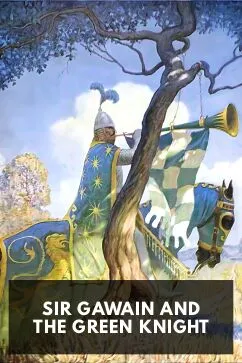
Quick overview
- Arthurian poem from the late 1300s
- Author unknown, one surviving manuscript
- Modern English verse version by S. O. Andrew, 1929
What is Sir Gawain and the Green Knight about?
Sir Gawain and the Green Knight is a Middle English poem from the late fourteenth century. It survives in a single manuscript, and its author is unknown. At a New Year feast in Camelot, a huge green knight rides into King Arthur's hall and offers a game: any knight may strike him with an axe, if he agrees to take a blow in return a year later.
Gawain cuts off the stranger's head. The knight picks it up and rides away. The rest of the poem follows Gawain's winter journey to the Green Chapel and three days in a castle where his honesty is tested. This edition is S. O. Andrew's modern English verse version from 1929, with his introduction, notes and glossary.
Read Sir Gawain and the Green Knight online
How to read it on a Kindle, Kobo or phone
Kindle: download the EPUB and send it with Amazon's Send to Kindle (web, app or email). Amazon converts it for your device. Kobo, Pocketbook, Apple Books and Google Play Books open the EPUB directly. The PDF keeps the page layout and suits printing or a large tablet.
Is Sir Gawain and the Green Knight free to download?
Yes. Sir Gawain and the Green Knight was first published c. 1400, so it is in the US public domain. The work is ancient and the translator died in 1952, so it is free in the EU as well. This edition comes from Standard Ebooks, which releases its texts under CC0.
What is Sir Gawain and the Green Knight about?
A green knight challenges Arthur's court to a beheading game. Gawain accepts, and a year later he must travel to the Green Chapel to receive the return blow.
Who wrote Sir Gawain and the Green Knight?
Nobody knows. The poet wrote in a north-west Midlands dialect around the end of the fourteenth century and is often called the Gawain Poet or the Pearl Poet.
Is this the original Middle English text?
No. This edition is S. O. Andrew's 1929 rendering into modern English verse, which keeps the alliteration and stanza form of the original.
 The OdysseyHomer
 MetamorphosesOvid
 BeowulfAnonymous
 Paradise LostJohn Milton
 The IliadHomer
 The Canterbury TalesGeoffrey Chaucer